
From artificial intelligence and telemedicine to wearable devices and precision medicine, health technology (health tech) is reshaping how care is delivered, managed, and experienced. For medical doctors, this evolution isn’t just a spectator sport; it’s an exciting frontier brimming with new career possibilities. In this guide, we are explaining real world jobs and career options available for medical doctors in the HealthTech domain. These are not ideas but paths which doctors have already taken. We have also provided LinkedIn profiles of doctors who have taken this path, to make you job search easier
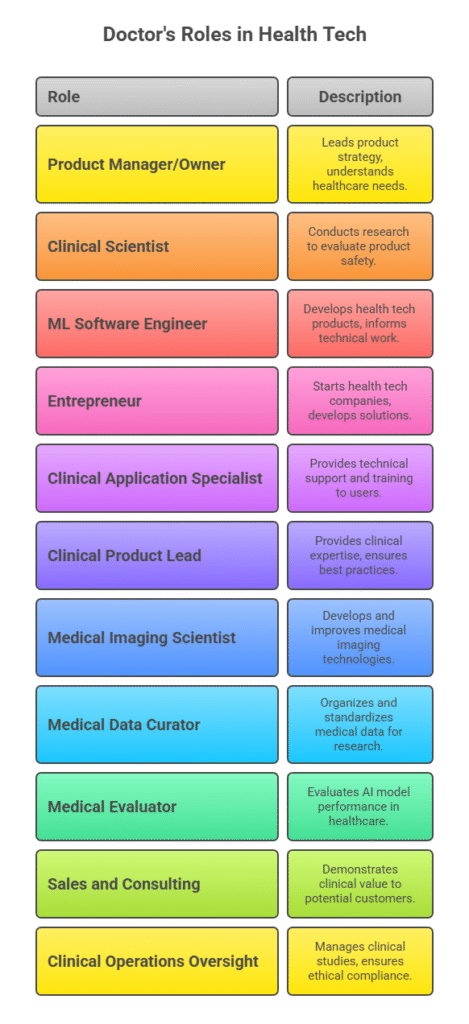
Product Development Roles
In product development roles, you are expected to lead a team of designers and developers to lead the development of a great final product which solves a burning problem. Doctors possess an intimate understanding of patient needs, clinical workflows, and the practical challenges faced by healthcare providers. This invaluable perspective makes them uniquely suited for roles in product development. For e.g. you could be asked to develop an app which automatically detects health parameters just by using the cellphone camera. Or to develop a software for which helps physicians diagnose and take decisions faster while minimizing errors.
Product Manager/Product Owner
In these pivotal roles, doctors lead the product strategy and development lifecycle, acting as the crucial bridge between engineering, design, and the clinical end-user. As a Product Manager or Product Owner, your clinical insight is paramount. You’ll be responsible for identifying unmet clinical needs, defining product features based on patient and clinician feedback, prioritizing development tasks, and ensuring that the final product addresses real-world healthcare problems. Your medical background allows you to deeply understand regulatory requirements, patient safety considerations, and the intricate nuances of clinical decision-making, ensuring that products are not only effective but also safe and compliant.
Profile 1: Dr Lokesh Rajpal
Profile 2: Dr Harshithaa Varatharajan
Profile 3: Dr Sujitkumar Hiwale
Clinical Product Lead
Similar to a Product Manager but often with a more focused clinical lens, a Clinical Product Lead guides product development primarily through the lens of clinical expertise and user feedback. This role involves working closely with product teams to translate complex medical requirements into actionable product specifications. You’ll often be involved in clinical validation, usability testing with healthcare professionals, and ensuring that the product integrates seamlessly into existing clinical workflows. Your job is to champion the clinical perspective, ensuring that the technology genuinely enhances care delivery and outcomes for both patients and providers.
Scientific and Research Roles
At the heart of health tech lies scientific rigor and continuous innovation. Doctors, trained in scientific inquiry and critical appraisal, are ideally suited to drive the research and development that underpins the next generation of healthcare solutions.
Clinical Scientist/ Engineer
As a Clinical Scientist in health tech, you will conduct research focused on the safety, efficacy, and clinical utility of health tech solutions. This involves designing studies, analyzing complex clinical data, interpreting results, and contributing to scientific publications. Your medical background provides a unique advantage in understanding the clinical context of data, identifying relevant endpoints, and ensuring that research aligns with patient needs and clinical best practices. You’ll be instrumental in building the evidence base that justifies the adoption of new technologies.
Profile: Dr Naveen Kumar
Profile: Dr Sandeep Kumar
Profile: Dr Mithun M.
Profile: Dr Sushant Nooji
Medical Imaging Scientist
For doctors with an interest in radiology, pathology, or related fields, a Medical Imaging Scientist role offers a chance to develop and improve medical imaging technologies, including AI-powered diagnostic tools. You’ll work at the intersection of medical science, computer vision, and engineering to enhance image acquisition, processing, analysis, and interpretation. Your clinical understanding of image characteristics, diagnostic challenges, and patient pathways is crucial for creating robust and clinically relevant imaging solutions.
Medical Data Curator
The explosion of health data presents both immense opportunities and significant challenges. A Medical Data Curator is crucial for organizing, standardizing, and annotating vast amounts of medical data, making it usable for research, AI model training, and clinical decision support systems. If you are a young doctor, you can try this role to dip your toes and get a feeling of the health tech world. Your medical knowledge will help improve the accuracy and clinical relevance of the curated data, safeguarding against misinterpretation and enabling the development of reliable AI algorithms. This role requires meticulous attention to detail and an understanding of medical terminology and coding systems (like ICD, HCPCS, LOINC, etc) and data governance principles.
Profile: Dr Jerin Verghese
Medical Evaluator/Validator
As a Medical Evaluator, particularly for AI models in healthcare, your role is to rigorously assess the performance, safety, and clinical relevance of these advanced algorithms. This involves testing models against real-world clinical scenarios, identifying potential biases, evaluating their impact on diagnostic accuracy and treatment decisions, and ensuring they meet ethical guidelines. Your clinical judgment is indispensable in determining whether an AI model is truly beneficial, reliable, and ready for integration into clinical practice, ultimately protecting patient safety and promoting effective use of technology.
Profile : Dr Swathi Sathish
Profile: Dr Amit Mondal
Clinical Operations Roles
The development and deployment of new health tech solutions often require rigorous clinical validation and ethical oversight. Doctors, with their deep understanding of research methodologies, patient care, and regulatory environments, are indispensable in managing these critical operations.
Clinical Operations Oversight
In health tech, Clinical Operations Oversight roles are vital for managing and ensuring the ethical conduct of clinical studies that validate new devices, software, or digital therapies. Your responsibilities might include designing robust clinical trial protocols, overseeing patient recruitment and consent processes, monitoring data integrity, and ensuring adherence to regulatory guidelines (e.g., FDA, HIPAA, EMA, GDPR). Leveraging your medical background, you’ll ensure that studies are not only scientifically sound but also prioritize patient safety and align with best clinical practices, translating complex medical data into clear operational strategies for the development team.
Medical Advisor
Medical advisors in MedTech/ pharma companies provide crucial clinical expertise to guide product development, marketing, and sales strategies by analyzing data, engaging with Key Opinion Leaders (KOLs), training internal teams, and ensuring regulatory compliance. They translate complex scientific and medical information into understandable language to support market penetration and contribute to strategic planning by identifying market needs and potential research avenues
Profile: Dr Raghavendran
Commercial and Sales Roles
The journey of innovative health tech from concept to widespread adoption requires compelling communication and a deep understanding of its value proposition for diverse stakeholders. Doctors, with their inherent credibility and understanding of clinical impact, are uniquely positioned to excel in commercial and sales functions.
Sales and Consulting
For doctors entering sales and consulting roles, your clinical credibility is a powerful asset. You can leverage your medical background to effectively demonstrate product value to hospitals, clinics, payers, and individual practitioners. Unlike traditional sales professionals, you can speak the language of clinicians, deeply understand their pain points, and articulate how a specific health tech solution can improve patient outcomes, enhance efficiency, or reduce costs from an evidence-based perspective. This builds trust and facilitates the adoption of new technologies, providing strategic advice on integration and utilization.
Profile: Dr Shubs Upadhyay
Clinical Application Specialist
A Clinical Application Specialist bridges the gap between the health tech product and its clinical users. In this role, doctors provide essential technical support, in-depth training, and hands-on guidance for health tech products. You’ll work directly with healthcare professionals to ensure they can effectively integrate and utilize new technologies in their practice. Your medical expertise allows you to troubleshoot clinical use cases, provide tailored education, and serve as a crucial feedback loop to product development teams, helping to refine features and improve user experience based on real-world clinical application.
Profile: Dr Ronnie Rajan
Entrepreneurship in MedTech
For many doctors, clinical experience unveils numerous inefficiencies, unmet needs, or areas ripe for innovation. Entrepreneurship in MedTech offers a direct path to address these challenges head-on.
Starting Your Own Health Tech Company
Starting your own health tech company allows you to innovate solutions based directly on your clinical experience and insights. You can identify pressing pain points in healthcare delivery, conceptualize novel technologies, and build a team to bring your vision to life. Your medical background provides an unparalleled advantage in understanding the market, designing clinically relevant products, navigating regulatory pathways, and articulating the value proposition to investors, partners, and early adopters. This path offers the potential for significant impact, transforming healthcare from the ground up.
Profile : Dr (Maj) Satish S Jeevannavar
Transitioning to Software Engineering
While requiring a significant shift in skillset, a handful of doctors are leveraging their analytical minds and deep domain knowledge to transition into software engineering, particularly in areas like machine learning.
Software Engineer (including ML Software Engineer)
For doctors willing to undergo rigorous technical training, roles as Software Engineers or Machine Learning Software Engineers offer a unique opportunity to apply their clinical knowledge directly to code. You’ll be involved in designing, developing, and deploying software solutions, algorithms, and AI models for health tech products. Your medical domain knowledge is invaluable in understanding the requirements of clinical systems, interpreting complex medical data, designing intuitive user interfaces for healthcare professionals, and ensuring the ethical considerations inherent in medical AI are baked into the development process. This transition often involves pursuing formal education in computer science, coding bootcamps, or self-study, followed by hands-on project experience.
Profile : Dr Mithun James
Profile: Dr Akshay Goel (Google)
Academic Career
If you are somebody who wants to pursue fundamental research and teaching and training the future students , academia is the best place for you. Academic careers for physician-scientists involve combining a medical degree (MD /MBBS) with a research degree (PhD) to conduct translational research, bridging basic science discoveries with clinical applications. The journey here may be a bit long (3-5 years of PhD, 2 years of post doc and then applying for the correct positions ) but it is truly rewarding. These roles are primarily found in academic health centers, where physician-scientists balance clinical practice, research, and teaching, often with a greater emphasis on research (e.g., 80% research, 20% clinical time)
Profile : Dr Amit Mehndiratta
Conclusion
The health tech sector offers an exciting and diverse array of career paths where doctors can significantly impact healthcare innovation, bridging clinical practice with technological advancement. Whether you’re drawn to product development, clinical validation, commercial strategy, scientific research, entrepreneurship, or even software engineering, your medical expertise is a highly valued asset. By leveraging your unique perspective and clinical acumen, you can play a pivotal role in shaping the future of healthcare, driving solutions that are not only technologically brilliant but also genuinely improve patient care and clinician experience. The opportunities are vast, and the impact you can make is profound.